

Payloads
mRNA Transfection
Synthetic messenger RNA (mRNA) has emerged as a transformative therapeutic modality, providing the genetic instructions required for cells to produce virtually any protein of interest.
This technology has revolutionized modern medicine by enabling new approaches to treat infectious diseases, cancer, and a wide range of cardiovascular, and neurodegenerative disorders. Unlike DNA-based therapies, mRNA functions entirely within the cytosol and does not require nuclear entry, eliminating the risk of genomic integration or insertional mutagenesis.
In addition, mRNA supports rapid, transient, and controllable protein expression, with translation often detectable within hours of successful delivery.
Gentle Cytosolic Delivery with LumiPore®
The success of mRNA-based applications relies on efficient intracellular delivery while preserving cell health and functionality. LumiPore addresses this challenge through a gentle photoporation mechanism that enables direct cytosolic delivery of mRNA with minimal cellular stress.
This approach supports robust protein expression in both established cell lines and sensitive primary cells, making it well suited for applications ranging from cell engineering and regenerative medicine to the development of next-generation mRNA therapeutics and vaccines.
Application Datasets & Scalability
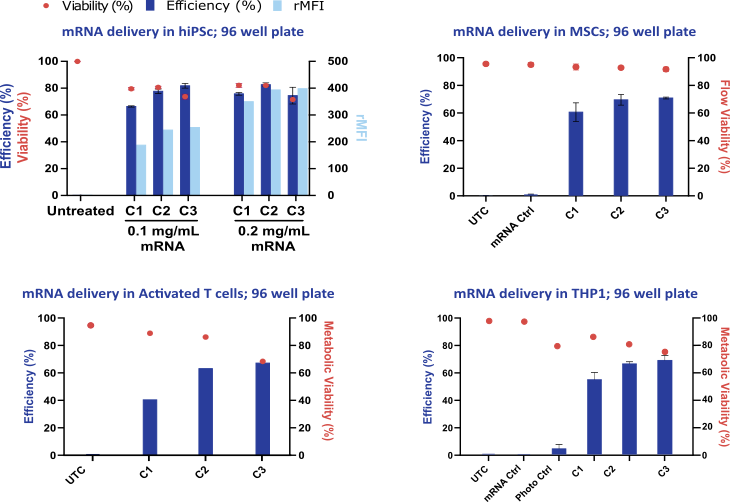
The following sections present representative examples of mRNA delivery achieved with the LumiPore platform across a range of cell lines and primary cells. These datasets, generated and validated in collaboration with research partners and customers, demonstrate the ability of LumiPore to support efficient protein expression while maintaining high cell viability and functionality.
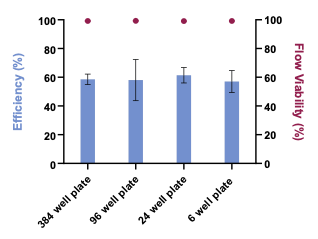
In addition, eGFP mRNA delivery data obtained from randomly distributed wells within 384-well plates and across multiple plate formats ranging from 6- to 1536-well plates are presented to highlight the platform’s exceptional intra- and inter-plate delivery consistency.
These results underscore the robustness, reproducibility, and scalability of LumiPore, making it particularly well suited for high-throughput screening and large-scale cell engineering workflows.
Additional experimental details, validated protocols, and application-specific recommendations can be found in the corresponding sections below.
High-Throughput Transfection.Automation-Ready.
Seamless integration into your existing robotics workflows. No media exchange required. From R&D suspensions to clinical nanofiber structures.